ASEAN Plus Three Emergency Rice Reserve 


This day, 7 October 2022, marks a day of 11th anniversary of the APTERR which have the main purposes on strengthening food security, alleviating poverty, and eradicating malnourishment in the time of emergency in ASEAN Plus Three (APT) region. Through these years, the APTERR has been implementing its activities in response to emergency situation occurred in the member countries amid the increasing intensity and frequency of disasters caused by climate change and global warming. For the last decade, over 30,000 MT amount of rice contributed by Malaysia, Thailand, the People’s Republic of China, Japan, and the Republic of Korea were released in order to help around five million people in emergency situations in Cambodia, Lao PDR, Myanmar, the Philippines, Thailand and Viet Nam. This proved that the APTERR plays an important role in providing humanitarian assistance and malnourishment eradication responding to emergencies and disasters.


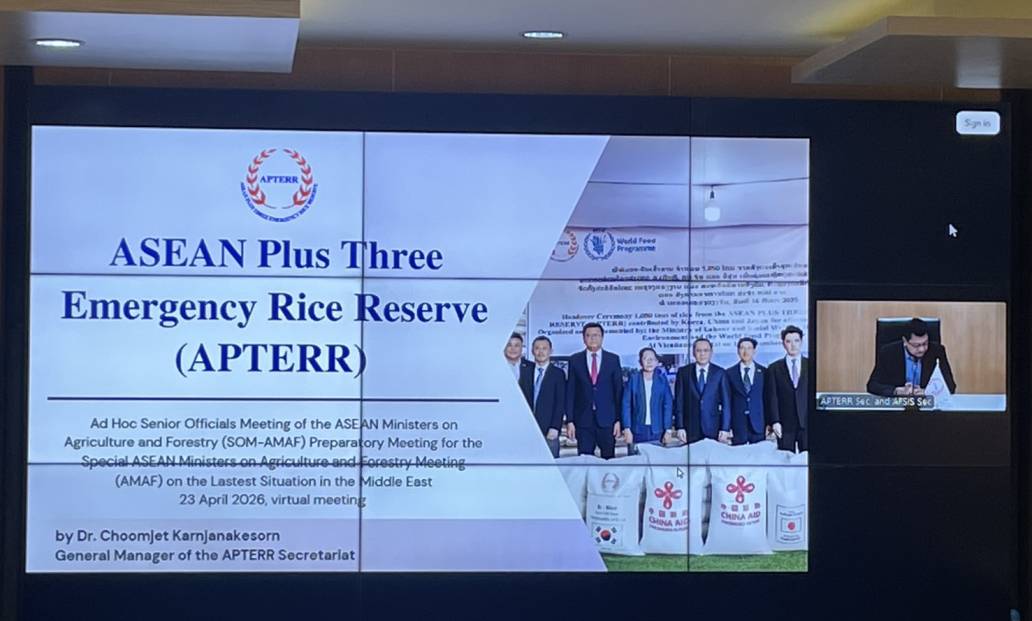
In order to achieve the goal, the APTERR Secretariat, under the guidance of Dr. Choomjet Karnjanakesorn, the new General Manager of APTERR Secretariat, continues to maintain the core activities of the APTERR and enhance visible roles of the APTERR by strengthening the collaboration and coordination with various regional and international agencies and institutions, namely ASEAN Secretariat (ASEC), Indonesian National Food Agency (NFA), World Food Programme (WFP) in Lao PDR, Mekong River Commission Secretariat (MRCS) in Lao PDR and MRC Flood Center in Cambodia, Amru Rice Co., Ltd. (the largest rice exporter in Cambodia), Geo-informatics and Space Technology Development Agency (GISTDA) - Thailand, Thai National Disaster Warning Center (NDWC), Thai Department of Foreign Trade as the ASEAN Food Security Reserve Board Secretariat (AFSRB Secretariat) and other institutions.

Recently, the climate change, COVID-19 pandemic, geopolitical conflicts have posed severe challenges to global governance of food security, and that food crisis is increasingly expected to prolong and spread. In this relation, the APTERR Secretariat has to closely monitor the situations in order to assess adverse impacts on food security and livelihood of local people in the APT region. Therefore, the APTERR will proactively implement its mechanisms to maintain its utility and efficiency in the APT region in order to achieve humanitarian purposes as well as Sustainable Development Goals (SDGs).


.


 Logo APTERR Eng 

 What is APTERR?


The ASEAN Plus Three Emergency Rice Reserve (APTERR) is a regional cooperation established under the APTERR Agreement signed by the Ministers of the Agriculture and Forestry of the ASEAN Plus Three at the 11th Meeting of the ASEAN Minister on Agriculture and Forestry Plus Three (AMAF+3) on 7 October 2011 in Jakarta, Indonesia. The APTERR was officially established itself as a permanent mechanism and also marked the official launch of the APTERR Secretariat office in Bangkok in 2013. 


We are keen to strengthen food security, poverty alleviation, and malnourishment eradication among its members without distorting normal trade, while the common goal of the APTERR Parties is the assurance of food security in the ASEAN+3 region. 


APTEERR Stock Overview APTEER Stock Marker Map with Animation

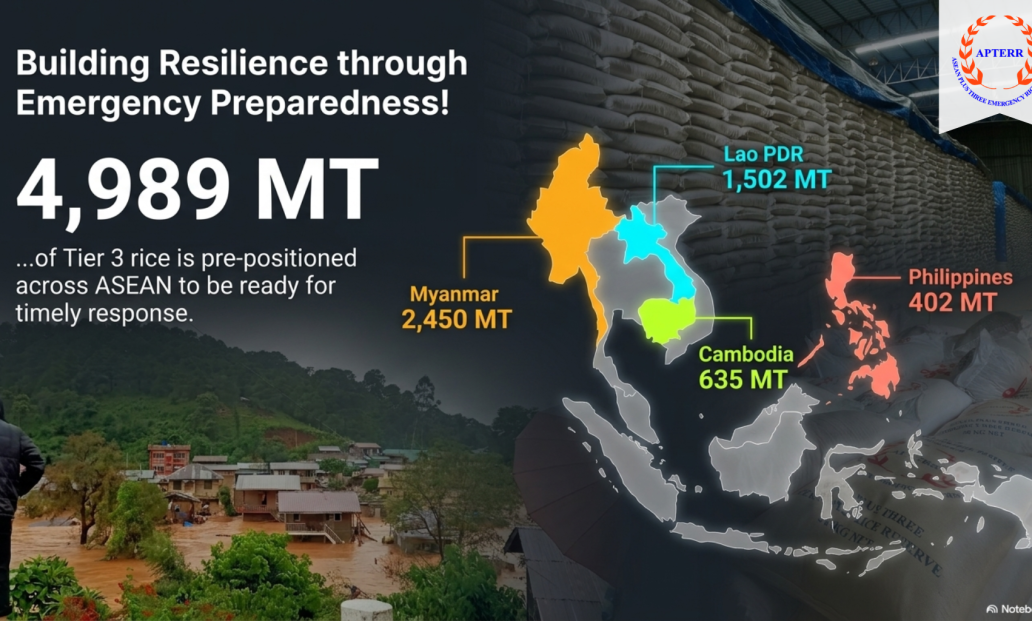
Current APTERR stock under Tier 3 in FY2025

**The pre-positioned stockpiled system under Tier 3 programme in FY 2025 to ensure a timely rice assistance to people affected by calamities

Current APTERR stock volume (MT)

Cambodia

275 MT

360 MT

Total :635 MT

Lao PDR

300 MT

302 MT

1,000 MT

Total :1,602 MT

Myanmar

375 MT

2,000 MT

Total :2,375 MT

Philippines

400 MT

Total :400 MT

Natural Disasters


Logo APTERR Eng

WEEKLY UPDATE ON NATURAL DISASTERS
IN ASEAN PLUS THREE

No. 463 792726210d1e7546b7ced88db6894424 

15 - 21 April 2026

  1. Indonesia
  2. Thailand
  3. Viet Nam
  4. Japan

Flooding forced many people in Indonesia to evacuate. Torrential rainfall between 15 and 18 April 2026 triggered flooding and river overflows across Java Island, Indonesia. In Bogor Regency, more than 2,000 people were affected, with one injured and around 25 displaced as of 20 April 2026. A total of 522 houses were damaged. In Klaten Regency, 33 people were also displaced and 34 houses were damaged.

Source: ReliefWeb. (2026, Apr 20).  Indonesia - Floods (ADINet, BMKG) (ECHO Daily Flash of 20 April 2026).

Extreme weather caused injures and damage in Thailand. According to the ASEAN Disaster Information Network’s report on 20 April 2026, powerful winds, thunderstorms, and hailstorms affected parts of Thailand between 14 and 16 April 2026. In south-eastern parts of Thailand, six people were injured in Buriram Province, while nearly 1,500 people were affected and 370 houses were damaged across Nakhon Phanom, Ubon Ratchathani, Buriram, and Sisaket provinces, with the most significant impacts reported in Ubon Ratchathani. In north-west regions of Thailand, more than 23,500 people were also affected and over 4,700 houses were damaged across 22 provinces, with the highest impacts reported in Phetchabun, Maha Sarakham, and Chaiyaphum.

Source: ReliefWeb. (2026, Apr 20).  Thailand - Severe weather (ADINet, TMD) (ECHO Daily Flash of 20 April 2026).

Hailstorm injured four people in Viet Nam. On 16 April 2026, a severe hailstorm hit Bac Ha Commune in Lao Cai Province, Viet Nam. The most significant damage was in Trung Tam Village. Debris caused by strong winds injured four people. A total of 338 houses were affected, including 333 with partial roof damage and five completely destroyed. In addition, 485.5 hectares of crops were damaged.

Source: The Watcher. (2026, Apr 17). Severe hailstorm damages hundreds of homes in Bắc Hà, Lào Cai Province, Vietnam.

A 7.7-magnitudes earthquake hit Japan. On 20 April 2026, a 7.7-magnitude earthquake struck off the northeastern coast of Japan. No casualties or major damage were immediately reported. However, several port towns, including Otsuchi and Kamaishi, issued evacuation orders for thousands of residents. Transport services were also disrupted, with bullet train operations suspended and some motorways temporarily closed. Following the quake, tsunami waves of up to 80 centimetres were observed. The initial tsunami warning was later downgraded to an advisory. No abnormalities were reported at nearby nuclear power plants.

Source: Reuters. (2026, Apr 20). Japan eases back tsunami warning after magnitude 7.7 quake, no immediate reports of casualties.

Rice Situation


Logo APTERR Eng

WEEKLY UPDATE ON RICE SITUATIONS 
IN ASEAN PLUS THREE

No. 463 792726210d1e7546b7ced88db6894424 

15 - 21 April 2026

  1. Philippines
  2. Thailand
  3. Republic of Korea

P20 rice programme serves as a strategic measure with over 6 million beneficiaries. The P20 Rice Programme is a government food security program that provides rice at PHP20 per kilo to vulnerable Filipinos. It has already reached more than six million people across 82 provinces nationwide, and the Department of Agriculture has expanded the program in Roxas City, Capiz. The Agriculture Secretary emphasized that the program is not just a subsidy measure but a strategic intervention to stabilise prices, protect vulnerable households, and ensure a reliable market for farmers. He added that its aggressive expansion not only cushions the impact of recent oil price surges but also advances the country’s food security targets. The PHP20 per kilo rice is available in 661 Kadiwa ng Pangulo centers, kiosks, and other DA-accredited sites nationwide.

Source: Philippine News Agency. (2026, April 20). P20 rice not mere subsidy, but ‘strategic’ action; 6M Filipinos .

The Thai rice price is increasing due to fuel and fertiliser costs escalating. Rice prices have increased sharply, with Thailand’s benchmark 5 percent broken rice rising 10 percent to 423 USD per tonne, marking the largest increase in two years. The spike is driven by rising fuel and fertiliser costs linked to the Middle East Tension. In Thailand, some farmers have reduced or stopped planting as rising costs outpace profits and make cultivation unsustainable. A prolonged dry season has further cut yields and tightened rice supply. Moreover, the stronger Thai baht, surging shipping, and insurance costs have also pushed prices up. Thailand, the world’s third-largest rice exporter, is currently harvesting its off-season crop and preparing for the next planting cycle.

Source: ET Retail. (2026, April 20). Rice prices in Asia soar as Iran war fallout threatens supply.

The Republic of Korea (ROK)’s rice production dropped for the fifth straight year. According to a report from the Foreign Agricultural Service (FAS) of the US Department of Agriculture, the rice production in the ROK is projected to decline for the fifth consecutive year, dropping to 3.5 million tonnes in 2026-27. The drop is driven by government policies encouraging farmers to shift to other crops and declining of rice consumption, which steadily dropped to 53.9 kilogrammes per capita in 2025. Meanwhile, wheat consumption is expected to rise to about 3.9 million tonnes, largely due to increased use in animal feed, and changing consumer habits, including demand for processed and ready-to-eat meals, are further reducing direct rice consumption. Government efforts to limit oversupply are also expected to reduce the amount of rice diverted to feed use, reinforcing the overall decline in production.

Source: World-Grain.com. (2026, April 16). South Korea's rice output to decline for fifth straight year.

Text Here